



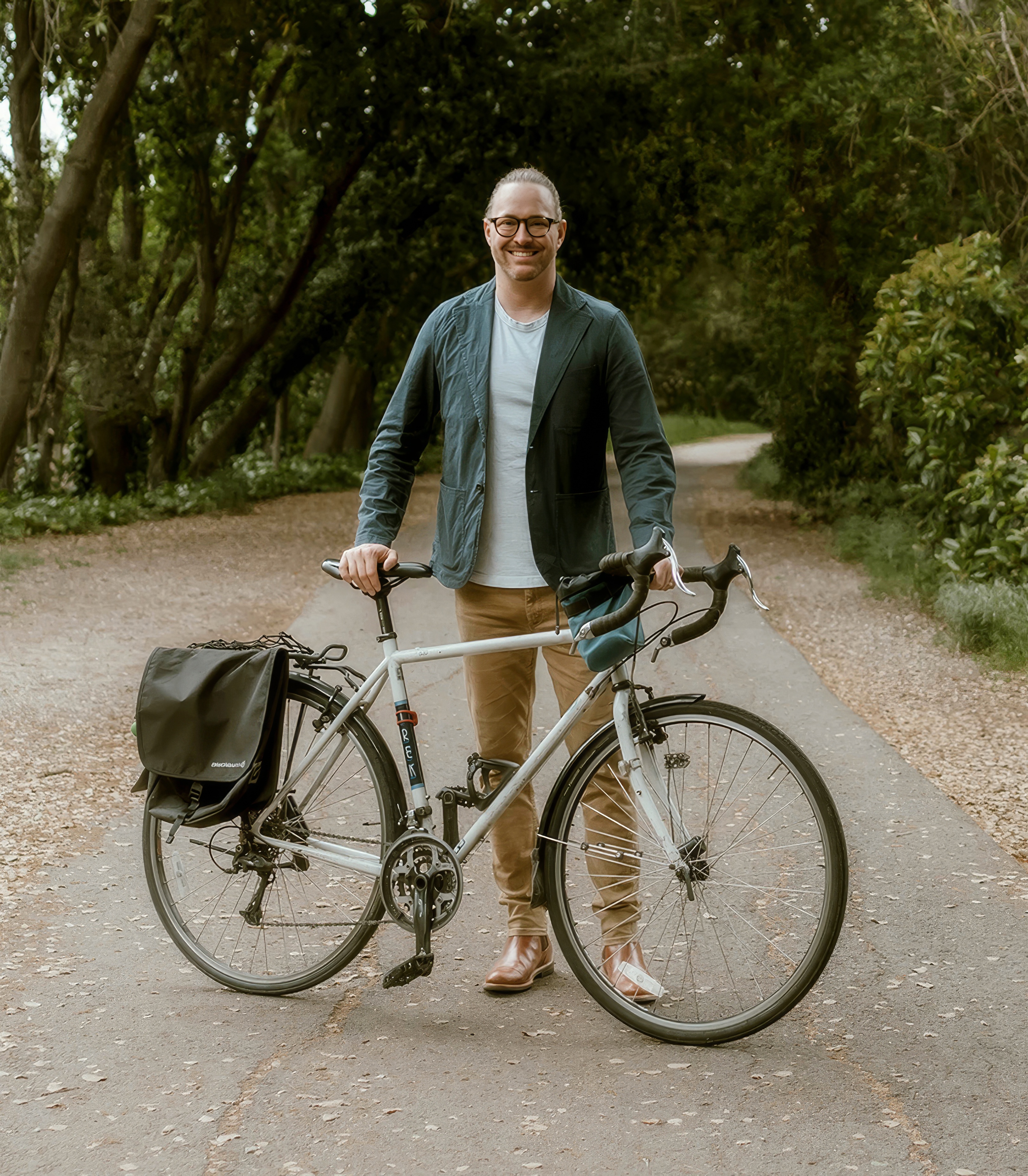
In a conversation with Arthur Rothrock on The Litigator's Path, Smith breaks down why getting fired from foreclosure defense was the best thing that ever happened to his career, how he learned to practice law from the ground up at a small plaintiff's firm, what it takes to niche down so hard that your entire brand is built around one type of case, and how he uses tech and AI to run a two-person operation handling cases across Northern California. The through line: building a sustainable plaintiff's practice around a genuine passion – cycling – gives you an advantage that no amount of marketing spend can replicate.
Why Foreclosure Defense Was a Bad Fit and What That Taught Him About Practice Areas
Kyle Smith graduated from law school in 2013, during the tail end of the financial crisis. He landed at a big firm doing foreclosure work for a major bank – closing on homes for families who couldn't make payments. He realized quickly he was in the wrong place. "I was like one missed paycheck away from losing my apartment," Smith recalls. "So yeah, man, I appreciate it. Hard for me to advocate for the bank when I feel a lot of compassion for their position that I'm very close to."
After a couple of years, the firm told him he didn't seem passionate about the work. Smith laughed. "I was kind of like, that's one way to say it," he says. "The compassion side of me, I think it was a bad fit." He describes the cognitive dissonance of spending every day defending institutions he didn't believe in: "If you have to wake up every day and kind of psych yourself up of like, I am a person who can do this job, then you might not be doing the right job for you."
A friend from Bay Area Bicycle Law reached out and asked if he'd be interested in doing bike law. Smith hadn't even known it was a thing. "It was one of those things where it kind of clicked like, wait, we can do that?" he says. The realization that he didn't have to stay in one firm for 35 years – that he could build a practice around something he actually cared about – was a turning point. Smith's takeaway: you can soldier through a job you hate for a while, but it will make you a more bitter, unhappy person before you realize it. Authenticity isn't optional in plaintiff's work. It's the foundation.
How Kyle Smith Learned to Practice Law by Getting Thrown in the Deep End at Bay Area Bicycle Law
Smith joined Bay Area Bicycle Law in 2017, working under founder Michael Stevenson. He describes Stevenson as one of the most fearless lawyers he's ever met – someone who operates with zero self-doubt and just makes things happen. "You start on Monday. Great. So you're going to take a deposition on Thursday," Smith says. "And coming from the big law world where you're like, oh, people don't need to take depositions until their fifth year. Is there something like that? It was, oh, that must be so scary."
But working at a small practice demystified litigation. Smith learned every part of a case from intake to settlement. He learned how to be comfortable with the possibility of losing – because in litigation, someone always does. "Getting what's best for your client is really the goal," he says. "And it doesn't have to be that everything is just an absolutely black and white, clear win, clear success." He also learned that you can take on cases you haven't handled before and figure them out. The only way to do something for the first time is to do it.
After nearly five years, Smith realized he'd hit a ceiling. In personal injury, there's no real partnership track at most small firms. "You're functionally asking them to give away 50% of their equity," Smith says. "Like, yeah, that'd be great. But it's also clearly kind of an insane business move from the ownership perspective." Stevenson was transparent about it: if you want to call the shots, you need to take the risk. So in 2022, Kyle Smith went solo and built Paceline Law. Stevenson referred him small cases early on – the kind that didn't justify his time but were perfect for a solo attorney working out of his house with zero overhead. That mentorship and initial referral base gave Smith the runway he needed to build his own practice.
Why Niching Down to Bicycle Crash Cases Makes Kyle Smith Stickier Than Broad-Based PI Firms
Kyle Smith's practice is almost entirely bicycle crash cases – auto versus bike collisions, product liability, dangerous road conditions. He admits he's leaving money on the table. "I fully admit that in terms of having the very unique or sort of narrow focus, you're going to miss out on a lot of other cases that are still within the world of personal injury and maybe are good cases," he says. "But to me, I would really rather just completely focus in on the thing I like doing in the community that I'm a part of and like solving problems for."
The niche makes him sticky. When someone posts in a group chat asking for a family law attorney, 10 people might respond. When they ask for a personal injury attorney, 15 people might respond. When they ask for a bicycle crash attorney, Kyle Smith is the one guy. "You miss out on the things that don't fit you exactly, but you have like a really good retention on the things that are the direct fit," he says. "And also, you know, when that person comes to me, I'm not sort of trying to be an expert on five different things."
Smith does handle some non-bike cases – car versus car collisions, slip and falls – but only when they come through referrals from past clients. "I have a few cases of car versus car collisions or a slip and fall or different, you know, things that are not bike related, but it's because I represented their friend three years ago who was in a bike collision," he says. His content and messaging are so focused on bike law that no one finds his website for anything else. But the trust he builds with bike clients spreads. "Clients will reach out to me and say, hey, I had a friend. It's not a bike thing, but they're injured. And I told him I liked working with you and that you really care a lot."
Kyle Smith's takeaway: if your goal is to build a 10-attorney firm with a big office, niching down might not be the best move. But if your goal is to have a good practice and a good quality of life, a niche makes you really sticky – and it lets you work on cases you actually care about.
How to Win a Bicycle Crash Case When the Police Report Blames Your Client
Kyle Smith has written on winning bicycle crash cases where the collision report blames the cyclist. It happens regularly. Sometimes the police are right – Smith recalls a potential client who was riding against traffic in the bike lane. "I'm like, whoa, let me stop you real quick. You can't ride against traffic. That's predictable is safe and safe is predictable. That's kind of the baseline. I'm so sorry you're injured and we can stay in touch. They'll help guide you through the process if you need to find doctors or good physical therapists or things like that. But you probably don't have a case."
But other times, the police are wrong. Smith sees cases where cyclists are blamed for riding on a sidewalk – even though there's no state law against it and many cities don't prohibit it either. Or cases where a cyclist is blamed for riding in a crosswalk and getting hit by a driver who ran a red light. "You're a legal violation is not the same thing as legal causation," Smith says. "I always tell people in that situation, it's like, can't be like, ah, well, he was murdered, but he was violating copyrights at the time. So what are we going to do? Yeah, we can address those concerns, you know, give them a ticket for, you know, the illegal downloads, but we need to prosecute this murder."
Smith's approach: start with the client's version of events, not the police report. Police reports are hearsay – they're not admissible evidence in court. The conclusions in police reports are often not supported by expert analysis. And in California, a comparative fault state, even a report that blames the cyclist primarily doesn't mean the driver isn't also at fault. "Sometimes I have to have that conversation with clients early on of, I think we're going to be able to reach a settlement, but you have to realize there's some degree of comparative fault here, whether it's 50-50 or 75-25 primarily on the driver and going into each situation and kind of just accepting the reality of it and working from there is the best way to go," Smith says.
When the facts are on the client's side – a cyclist riding in the bike lane who gets doored, for example, and the police report blames them for no reason – Smith goes in guns blazing and takes nothing short of full liability. And the insurance companies, he says, aren't going to stand on a ridiculous police report just because it exists. "If the facts are on your side, you can still come out on top."
Why Educating Insurance Adjusters About $25,000 Bikes Is Part of the Job
Kyle Smith's most expensive bike replacement case was around $25,000. The client was a professional triathlete – 6'6" or 6'7", a former swimmer. He went to a bike shop and they told him they don't make many bikes for someone his size, but they could build him one. It was fully custom. Another client had a titanium bike – a production model, but titanium bikes don't wear out, so they don't get replaced often. An adjuster found the same model on eBay for a suspiciously low price. Smith asked to see it. The eBay bike was a size 48 centimeters. Smith's client rode a 62 centimeter frame. "You know, funny where it felt like, hey, I know you spilled something on your shirt, but I have this toddler sweater. Like, will that work for you? And you're like, no. These things come in sizes, man. It's not a Camry."
In car versus car collisions, insurance companies deal primarily with property damage and low bodily injury. Most car collisions happen at low speeds. Cars are fungible – if you total a 2019 Prius with 80,000 miles, they can find you that same car. Bikes are different. They're sized to the individual. They change drastically year to year. A lot of cyclists have custom builds. "A 10-year-old bike is so different from a really modern bike," Smith says. "And that a lot of times people have custom bikes. I realize custom cars exist, but they're a lot more rare than custom bikes."
The adjusters Smith deals with are used to blue book values and standardized parts. They're not used to explaining why a bike costs as much as a used car. "There's just no blue book for bikes or human suffering," Smith says. "And so I think that with the kind of work I do, things are just always really hyper individualized in a way that does not always work with the insurance industry. That's very one size fits all."
How Kyle Smith Uses AI and Tech to Run a Two-Person Practice Across Northern California
Kyle Smith runs Paceline Law with one assistant – his brother, who works remotely. He uses Clio for case management and started using Clio Grow (formerly Lexicata) back when he was at Bay Area Bicycle Law. "It was the most amazing way to streamline client onboarding," Smith says. "Clients have a lot of choice. And so making it easy to sign the representation agreement and work with you, I think is really important in removing friction at step one." Clio Grow automates representation agreements, general authorizations, HIPAA forms – clients can sign electronically from their phone or computer. "Even setting things up for DocuSign takes longer than that. Or you would have... If you're mailing people... representation agreements with a return envelope, things like that that are cumbersome can just reduce time getting started."
Smith uses AI to summarize medical records. If he gets a 1,000-page hospital record, he'll have AI review it first to get a high-level summary of injuries and rough ballpark costs. "Just so that I think, you know, as I'm going into anything, it helps to have that sort of top level summary and then, you know, go in and make sure that AI was correct, certainly. And there's granular things it doesn't pick up." He also uses AI to calendar court orders – Clio will auto-populate trial dates, discovery cutoffs, and all the key deadlines. "Those kinds of things are where I think AI is really cool," Smith says.
But there are places AI doesn't work. Smith will never use an AI chatbot for client intakes. "I was like, oh, man, if I... empathy is my superpower in this. I was like, I was kicked out of the world of banking. I wasn't passionate about foreclosures. I'm passionate about helping people. So if I have to outsource that one to AI, I should hang it up and stop doing what I'm doing." AI can't capture the individual impact of an injury – the ski trip that got canceled, the grandparent who couldn't hold their new grandchild, the cyclist who used to love riding and now won't get back on a bike. "The documents won't show that," Smith says. "Things that are, to me, the biggest impact of a case, AI is just not primed for it."
Kyle Smith's workflow: AI for admin tasks, document summarization, and calendaring. Human work for client relationships, storytelling, and anything that requires judgment about individual impact. He still handwrites checks to clients when he closes cases. "I know I could print the checks, but to me, I feel like the actual exercise of doing it by hand is also kind of a good last step of... Like, hey, this is a real person who is really impacted by this."
What Litigators Can Take Away
Niche down hard if you want to be the only name people think of. Kyle Smith's practice is 90% bicycle crash cases. He admits he's leaving money on the table, but the trade-off is that when someone needs a bike crash attorney, he's the one guy everyone knows. That stickiness – being the only answer to a very specific question – gives him a referral advantage that broad-based PI firms can't replicate.
A bad police report doesn't kill a case if the facts are on your side. Smith has won cases where the collision report blamed his client for riding on a sidewalk, riding in a crosswalk, or other Vehicle Code violations that weren't the proximate cause of the collision. Police reports are hearsay. Insurance companies know that. If the underlying facts support liability, the report is just noise.
You can't make partner at most small PI firms, so plan to go solo or stay an employee forever. Smith's mentor at Bay Area Bicycle Law was transparent: he wasn't going to give away 50% of his equity, but he would teach Kyle how to build his own practice. That's the reality in personal injury – there's no partnership track at most solo and small firms. If you want equity, you have to take the risk of starting your own shop.
Empathy is a competitive advantage, and you can't outsource it to AI. Kyle Smith got fired from foreclosure defense because he wasn't passionate about the work. That same empathy is now his superpower. He refuses to use AI chatbots for client intakes because the personal connection is the entire point. If you're in plaintiff's work and you're not good at the human side, you're in the wrong practice area.
Build a practice around something you actually care about, or you'll burn out. Smith is a lifelong cyclist. His firm name – Paceline Law – comes from the cycling formation where riders draft behind one another to reduce wind resistance. His entire brand is built around a community he belongs to. That authenticity makes him better at the work and makes the work sustainable long-term.
Listen to the Full Episode
Hear the full conversation with Kyle Smith on The Litigator's Path. Learn more about how he niches down to bicycle crash cases, how he wins cases despite adverse police reports, and what tech he uses to run a two-person practice across Northern California. Listen on Apple Podcasts or at legion.law/podcasts. To learn how Legion helps litigators draft complaints, discovery, and motions in minutes, visit legion.law.